

Is Sunscreen Bad for You? Here’s What You Actually Need to Know
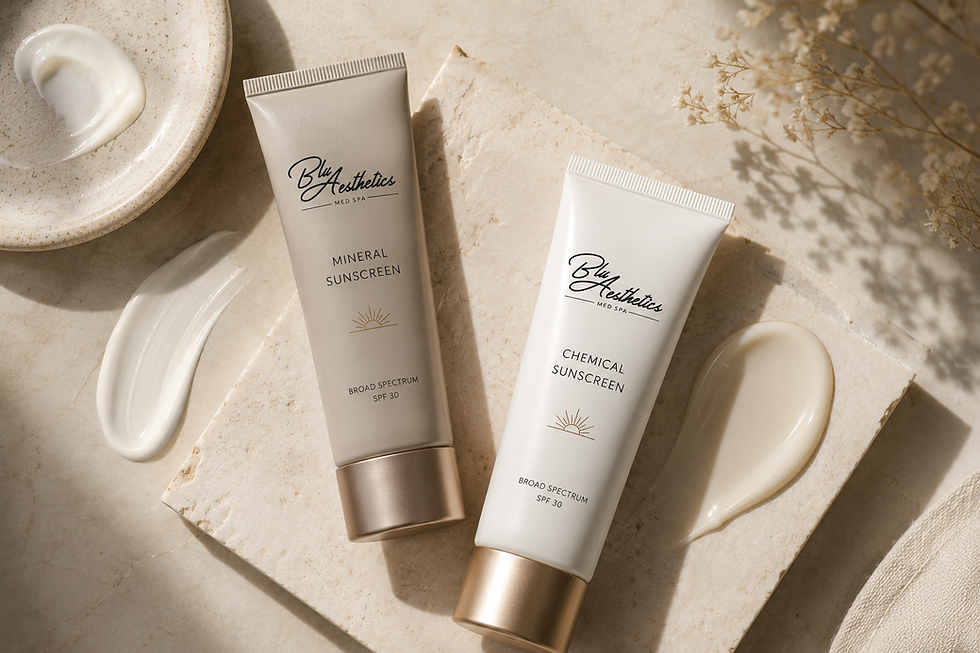
Mineral vs. chemical sunscreen, what’s the difference, and does it really matter?
If you’ve been on social media lately, you’ve probably seen it:
“Sunscreen is toxic.”“Stop wearing sunscreen.”“The ingredients are worse than the sun.”
And suddenly, the product we’ve been told to wear every single day has become one of the most debated products in skincare.
So… should you stop wearing sunscreen?
No. But you should understand what you’re putting on your skin.
The conversation around sunscreen is more nuanced than “sunscreen is good” or “sunscreen is bad.” There are different types of sunscreen, different active ingredients, and very different formulations.
Let’s break down one of the biggest distinctions: mineral sunscreen vs. chemical sunscreen.
First, Why Sunscreen Still Matters
Before we get into ingredients, there’s one thing we don’t want to get lost in the conversation: UV exposure damages your skin.
Sun exposure contributes to premature aging, hyperpigmentation, fine lines, changes in skin texture, and an increased risk of skin cancer.
And from an aesthetic standpoint? You can invest in lasers, facials, injectables, medical-grade skincare, and skin tightening, but if you’re consistently exposing unprotected skin to UV damage, you’re working against your own results.
SPF is one of the most important parts of a good skincare routine.
The question isn't whether you should protect your skin.
It's how you're protecting it.
Mineral Sunscreen vs. Chemical Sunscreen
The biggest difference comes down to the UV filters used in the formula.
Mineral Sunscreen
Mineral sunscreens use active ingredients such as zinc oxide and titanium dioxide.
These ingredients provide broad-spectrum UV protection and work at the surface of the skin to help protect it from damaging ultraviolet radiation.
Mineral sunscreens are often a great option for people with:
• Sensitive skin• Rosacea or redness-prone skin• Acne-prone skin• Melasma or hyperpigmentation concerns• Skin recovering from certain professional treatments• Anyone who prefers mineral UV filters
Modern mineral sunscreens have also come a LONG way.
If you're picturing the thick, chalky white sunscreen your mom covered you in at the beach when you were five, we promise there are much better options now.
Today's high-quality mineral SPFs can be lightweight, tinted, hydrating, and beautiful under makeup.
Chemical Sunscreen
Chemical sunscreens use organic UV filters such as avobenzone, octisalate, octocrylene, homosalate, and others, depending on the formulation.
These filters absorb UV radiation and convert that energy into a small amount of heat that is then released from the skin.
Chemical sunscreens are popular because they can be extremely lightweight, blend easily, and typically leave little to no white cast.
So why are people questioning them?
Where Did the “Sunscreen Is Bad for You” Conversation Come From?
Some of the concern comes from research showing that certain chemical sunscreen ingredients can be absorbed into the bloodstream at levels that warrant additional safety testing.
That sounds scary when reduced to a 10-second social media video.
But here's the important part:
Absorption does not automatically mean an ingredient is harmful.
The FDA has requested additional safety data on several sunscreen ingredients, but that is not the same as determining that sunscreen causes harm or that people should stop using it.
In fact, public-health and dermatology organizations continue to recommend sun protection because the risks associated with excessive UV exposure are well established.
So rather than panicking and throwing away every bottle of SPF in your bathroom, this conversation can be used for something much more productive:
Become an educated consumer.
Why We Love Mineral SPF
For many of our patients, mineral sunscreen is an easy choice because zinc oxide and titanium dioxide have a long history of use and are currently the sunscreen active ingredients the FDA recognizes as generally regarded as safe and effective based on available evidence.
We especially love mineral SPF when we're working toward healthier, clearer, more even-toned skin.
And if you're investing in treatments to improve pigmentation, texture, redness, or signs of aging, daily sun protection isn't optional if you want to protect those results.
Think of it this way:
Your treatments help correct the damage. Your SPF helps prevent more of it.
But “Mineral” Doesn't Automatically Mean “Perfect”
This is where skincare gets interesting.
Just because the front of a bottle says MINERAL doesn't automatically make it the best sunscreen for your skin.
The entire formulation matters.
Does it provide broad-spectrum protection?Is it SPF 30 or higher?Will you actually wear enough of it?Does it work with your skin type?Will you reapply it?
Because the “perfect” sunscreen sitting untouched in your bathroom cabinet isn't protecting anyone.
The best SPF is one that provides appropriate protection and that you'll consistently wear.
What Should You Look for in a Sunscreen?
When choosing your daily SPF, we generally recommend looking for:
Broad-spectrum protection to help protect against both UVA and UVB rays.
SPF 30 or higher for everyday use.
Zinc oxide and/or titanium dioxide if you prefer a mineral formula.
A formulation designed for your skin type, especially if you're acne-prone, sensitive, dry, or dealing with pigmentation.
And most importantly…
Use enough and reapply.
SPF in your makeup alone usually isn't enough, especially if you're spending meaningful time outdoors.
The Bottom Line
No, you don't need to be afraid of sunscreen.
But you also don't need to blindly buy whatever SPF happens to be sitting closest to the checkout line.
There is a difference between sunscreen formulations, and understanding those differences allows you to make a more informed choice for your skin.
For patients who are concerned about chemical filters or simply want a gentle, effective option, mineral sunscreen can be an excellent choice.
And if you're spending hundreds or thousands of dollars improving your skin?
Protect the investment.
At Blu Aesthetics, we can help you choose a professional-grade SPF based on your skin type, concerns, treatments, and lifestyle, because sun protection shouldn't be one-size-fits-all.
Not sure which SPF is right for your skin? Ask us at your next appointment or stop in and let our team help you find your perfect match.


Comments